Phlebotomy Classes and Training Programs in Berkeley, CA
CDPH-approved options near Berkeley, with costs, schedules and clinical details
By Marcella Sanchez, CPTReviewed by Editorial TeamUpdated November 4, 202621 min read
Most important takeaways…
No CDPH-approved phlebotomy program operates inside Berkeley itself 2027.
California requires 40 classroom hours plus 40 clinical hours before exam.
Commute options include City College of San Francisco and East Bay hospitals.
For Berkeley residents, the tradeoff is commute against schedule and price. The 2026 CDPH list of approved schools shows no phlebotomy program inside city limits. The nearest options are in Oakland and San Francisco, with others in Antioch, Livermore and farther out.
Training is short, usually 4 to 16 weeks and 40 to 200 hours. California is one of only four states that certify phlebotomists at the state level. A first job drawing blood here requires a CDPH-approved program, a passed national exam and a CPT I certificate.
Check the clinical half first. The 40 supervised hours, including 50 venipunctures, happen at a site the program must secure for you. See the ranked programs →
Are There Phlebotomy Classes in Berkeley Itself?
Is there a phlebotomy program in Berkeley, California? Not according to the state's approved list. California requires every phlebotomy training program to be approved by CDPH Laboratory Field Services, and the 2026 list of approved schools does not include a phlebotomy training site inside Berkeley city limits. Berkeley appears in CDPH materials only as the mailing address for the Northern California Regional Laboratory Accrediting Agency, which is a credentialing office, not a school.
Two Dead Ends Behind the Confusion
Berkeley College: this is a New Jersey and New York institution with no Berkeley, California campus and no phlebotomy program, despite what a search engine may suggest.
UC Berkeley: the university does not offer a phlebotomy certificate in anything reviewed for this page.
Where Berkeley Students Enroll Instead
The CDPH-approved options nearest Berkeley in the research sit across the bay in San Francisco: Bay Area Medical Academy, a private career school, and City College of San Francisco, a community college. Those are two different products. A community college certificate runs on an academic calendar with posted registration dates, while a private career school typically starts cohorts on a rolling schedule. Because the state list also carries approved programs in other Bay Area cities and in Contra Costa County, pull the current CDPH approved-school page and confirm the entry is live before any deposit changes hands. Approval status, not a familiar city name, is what makes a program count toward California certification.
The Commute Is Part of the Decision
Most Berkeley students ride BART or drive to class in another city, so treat transit as a real filter rather than an afterthought. A short BART hop from the Downtown Berkeley station keeps an evening lecture workable; a two-transfer drive to a 7 a.m. clinical draw session wears thin fast. Check the class schedule against your work shift, confirm how the clinical hours are arranged, and weigh the school's name last.
Where East Bay Phlebotomists Work
Hospitals and Health Systems
Sutter Health posts phlebotomy roles at its Alta Bates Summit sites in Berkeley and Oakland, covering venipuncture, skin puncture and specimen handling.1 UC Berkeley hires a Certified Phlebotomy Technician 1 at University Health Services, listed at $28.62 to $32.84 an hour.2 Farther out, Stanford Health Care Tri-Valley in Pleasanton has advertised a part-time rotating phlebotomist role.2 Inpatient hospital work typically front-loads the day with early-morning draws on the floors so results are ready before physicians round. Expect early shifts and a quick pace.
Labs and Patient Service Centers
Outpatient draw stations run steadier hours. Quest Diagnostics lists a Berkeley Phlebotomist I at $23.55 to $28.05 an hour, Monday through Friday from 8 to 5 with rotating weekends.3 Labcorp has Berkeley and Oakland openings.2 The Berkeley role pays $20.75 to $26 an hour on a similar weekday schedule. Quest's posting requires a California state license and says it does not accept NHA credentials in California, a detail that matters before you choose an exam.3
Mobile and Blood Collection
The American Red Cross in San Leandro has posted blood-collection staff jobs at $23.93 an hour.1 Blood drive work means travel and setup at changing sites. Getlabs hires PRN mobile phlebotomists in Oakland at $28 to $30 an hour for at-home draws, and Sprinter Health has listed temporary mobile roles in Oakland.4
Employer Training and Your School Choice
UCSF Health runs workforce development programs for its own employees that include phlebotomist training, so treat it as an internal pathway rather than a public class.5 When you talk to a school, ask which of these employers host its externship students. Externship sites often become first employers.
College Certificates vs. Private Training Centers Near Berkeley
City College of San Francisco runs its HCT 104: Phlebotomy Technician course on a 16-week semester calendar. Private career schools in the region package phlebotomy differently, often inside longer programs with more schedule choices. Which model fits your week matters more than the label.
The Community College Route
CCSF's Fall 2026 section runs September 2 to December 22. It meets Wednesdays from 1:10 to 7:15 p.m., then continues from 7:25 to 8:55 p.m., and carries 5.5 units. Community college fees are charged by the unit, and enrolling as a college student can make you eligible for financial aid.
The tradeoff is timing. You get one cohort per semester, and the published section is a single long weekday block, not an evening or weekend option. The college doesn't break out how much of the 5.5 units is lecture versus clinical, so ask before you register.
The Private Career School Route
Contra Costa Medical Career College offers Medical Assisting with Phlebotomy, not a phlebotomy-only course. The school says it takes as few as 35 weeks and 640 clock hours:
Classroom: 300 hours
Lab: 100 hours
Clinical externship: 160 hours
Clinical practical: 80 hours
Class blocks run 10 weeks in three formats:
Day: Monday to Thursday, 9 a.m. to 1 p.m.
Mid-day: 1:30 to 5:30 p.m.
Evening: 6 to 10 p.m.
Clinical hours are expected during the daytime, so evening students still need daytime availability. The 2026 catalog listed August 3 and October 12 starts. Both have passed, so request the next date. Also ask how the 10-week blocks fit into the 35-week total, because the school's published materials don't explain it.
Online and Hybrid: What's Realistic
CCSF says its classes may be offered on campus or online, but that doesn't confirm HCT 104 itself is hybrid. Contra Costa Medical Career College also sells a 20-hour, self-paced Advanced Phlebotomy e-learning course. Nothing shows it works as a complete certification program on its own.
California requires in-person practical training and supervised draws, so no fully online class leads to CPT I. Lectures can move online, but the needle work stays in person.
What Phlebotomy Classes Cost Around Berkeley, and How to Pay Less
California approves phlebotomy schools but does not set their prices, so the same certification can cost very different amounts depending on where you train.
Tuition and the Costs Around It
I can't give you a verified 2026 tuition figure for the Bay Area schools. The state's approved-school list names Quest Nursing Education Center, and a directory lists Bay Area Medical Academy in San Francisco, but neither source publishes current tuition or an itemized fee schedule.2 Get those numbers from the schools directly.
One fee is confirmed. The California Department of Public Health (CDPH) charges a non-refundable $100 application fee for the phlebotomy certificate, and you must pass a CDPH-approved national certifying exam. Check with CDPH that this applies to your applicant category. The fee that CDPH's program-approval FAQ lists as $0 is for schools applying for approval, not for you.
Beyond tuition and the state fee, plan for items that vary by school:
Exam fee: The national certification exam is usually paid separately.
Supplies: Scrubs, textbooks and a registration fee may or may not be bundled in.
Compliance: A Live Scan background check, immunizations and a TB test are typical clinical requirements.
Community college certificates are generally priced per unit, with books and supplies on top. Private schools usually quote one bundled price. Compare the all-in totals, not the headline numbers. Ask each school whether it accepts federal financial aid or offers a payment plan, because I couldn't confirm either for these programs.
What About Free Classes?
Assume no program here is free. What exists is possible funding for eligible residents through the Workforce Innovation and Opportunity Act (WIOA).
Alameda County's workforce board anticipated up to $1.25 million in WIOA funds for an initial 12-month contract period.1 That is an aggregate contracting figure, not a per-student benefit, and it doesn't mean phlebotomy training is covered. Contra Costa's process shows how it works: you register with CalJOBS, and the training provider and the specific program must both be approved on the Eligible Training Provider List. A school that isn't on the list can't be paid with WIOA money.
To find out whether you qualify, contact your county workforce board or the nearest America's Job Center of California. Ask whether your target program is on the Eligible Training Provider List before you enroll. I found no employer sponsor confirmed for local training, so don't count on one unless an employer offers it to you in writing.
Tip: ask every school for a written total cost, not just tuition.
Clinical Training and Externships: Where Students Draw
California requires at least 40 hours of supervised clinical practice for CPT I applicants with little or no work experience, and that time must include 50 venipunctures, 10 skin punctures and observation of arterial punctures.1 No CDPH-approved program can skip those minimums, so the differences that matter are how each school delivers the hours and whether you actually get the sticks.
Skills lab first, then a live site
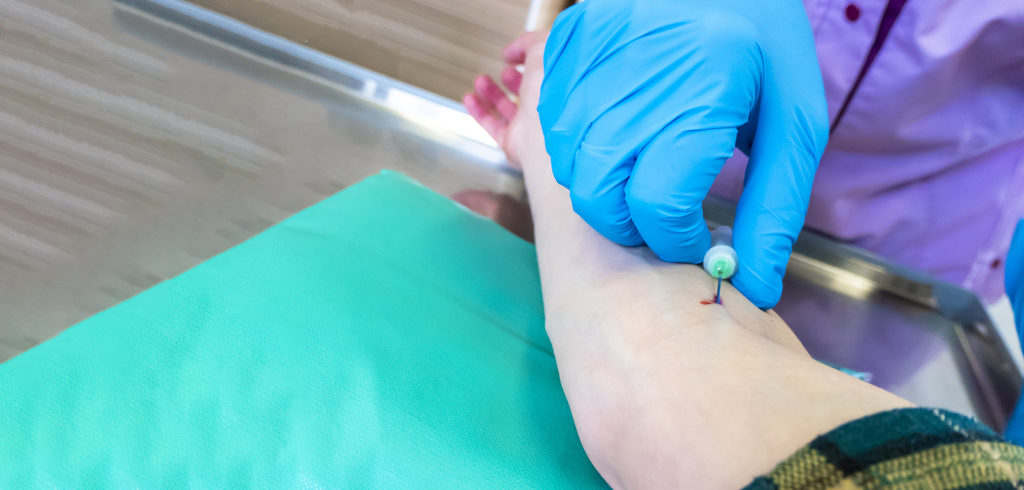
Classroom hours come first: students practice holds, needle angles and tube order on training arms before they draw from a classmate or a patient. Then comes the externship. BAMA Institute, which serves the Bay Area, assigns a 40 to 160 hour clinical externship after students pass the national certification exam.2 Its materials point to more than 50 partner facilities and more than 100 contracts with labs, hospitals and clinics, with named examples including San Francisco General Hospital, Kaiser Permanente, Concentra, California Pacific Medical Center, SF City Clinic, San Mateo County General Hospital and Palo Alto Medical Foundation.3 Applicants with 1,040 or more hours of qualifying work experience follow a shorter pathway, but first-time students should plan on the full 40 hours and 50 successful draws.
What the materials do not promise
BAMA describes assignment to a facility and a broad partner network, but its published materials do not explicitly guarantee placement for every student, promise a site of your choosing, or confirm that every named site hosts every cohort.
Four questions to ask admissions
Guarantee: Does the school place me, or do I secure my own site?
Wait time: How long after the classroom portion does placement typically begin?
Geography: Are the sites in the East Bay, or will I cross the Bay to draw?
Billing: Program materials present the externship as part of the program; confirm in writing whether background checks, drug screens, uniforms or site fees are billed separately.4
Get the placement answer in writing, and ask how the program documents your venipuncture and skin puncture counts before you pay tuition.
How Long Does It Take to Become a Phlebotomist in California?
California sets the hours, not the calendar. The state requires 40 hours of classroom instruction and 40 hours of clinical practice before you sit a national exam, and most students move through a program in roughly a few weeks to a semester. The steps below run in order, and each one has to be finished before the next counts.
Bring this list to every admissions conversation, the answers separate a program you can finish from one that stalls halfway.
Is the program CDPH-approved?
Ask for the approval status in writing, then confirm the school appears on the California Department of Public Health list yourself. Approval is what lets you sit for certification after finishing.
What is the total cost, in writing?
Get tuition plus every add-on itemized: national exam fee, CDPH certification fee, Live Scan fingerprinting, scrubs, books and any clinical surcharge. Compare that bottom line, not the flyer price.
Is the externship guaranteed?
Ask whether clinical placement is included or arranged by the student, which sites host students, and what shift times are available, a placement you have to find yourself can delay graduation by months.
What schedules and start dates are offered?
Confirm whether evening, weekend or accelerated cohorts exist for your cohort, and how often new classes begin. Ask how many students per instructor in the skills lab.
How do I get there?
Ask for the nearest BART station or AC Transit line to both the classroom and the clinical site, and whether clinical placements may be assigned outside Berkeley.
Which national exam does the program prepare me for?
Programs typically prepare students for the NHA CPT, ASCP PBT, AMT RPT or NCCT NCPT. Ask which one, its pass rate for recent graduates, and whether the exam fee is already covered.
What are the entry requirements?
Confirm the high school diploma or GED requirement, minimum age, required immunizations and TB testing, and whether a background check or drug screen is part of admission or clinical placement.
Top-Ranked Phlebotomy Programs for Berkeley Students
Below are the top phlebotomy programs serving Berkeley students, ranked by cost, outcomes and program fit. None of these campuses sits inside Berkeley itself, so each card names the city you would commute to and what that trip looks like. Net prices are the published figures after aid, and graduation rates describe the whole institution rather than the phlebotomy certificate alone.
How we ranked these
Factors considered
Net price after financial aid
Median graduate debt loads
Program length and schedule options
Clinical hours and externship access
Graduation rate, weighted lightly
Data sources
NCES-IPEDS federal institutional data covering graduation rates, retention rates and student-faculty ratios — nces.ed.gov
Contra Costa Medical Career College is a small private career school in Antioch, at the end of the BART Yellow Line once you make the eBART transfer, so it is a longer ride than most East Bay options. Its phlebotomy training is built for speed and flexibility: the same Certificate of Completion runs in 4, 5 or 10 weeks, including a weekend-only track for people who already work weekdays. The college reports a 100 percent institution-wide graduation rate and a median federal debt load of about $6,333, and graduates of the phlebotomy certificate had median earnings of $44,990 one year after completion.
4, 5 or 10 week formats, including a weekend-only 5 week track
120 clock hours: 40 lecture plus 80 practical training hours
7 quarter credit hours, awarded a Certificate of Completion
Prepares students for the NHA Certified Phlebotomy Technician exam
Meets California state certification requirements
High school diploma or GED required for admission
Financial aid, grants, scholarships and student loans for those who qualify
Avocational course built to supplement existing healthcare experience
Budget-focused students wanting a college certificate
City College of San Francisco offers the most affordable route on this list: a one-semester Certificate of Accomplishment with a net price of $6,906 after aid and an institution-wide graduation rate of 40 percent. Classes meet Wednesdays at the John Adams Center with afternoon or evening labs, and the campus is reachable from Berkeley by BART, which makes the cross-bay commute realistic for a one-semester commitment. Median federal debt for completers is $8,218.
One-semester Certificate of Accomplishment, two courses total
40 lecture hours plus 40 hands-on clinical hours
Students practice 50 venipunctures and 10 skin punctures
Prepares for the California CPT-1 certification exam
Wednesday classes at the John Adams Center, lab afternoon or evening
CPR certification included with the certificate
Information session, college-level English readiness and diploma required
Covers infection control, medical terminology and patient preparation
The Institute for Business and Technology in North San Jose teaches phlebotomy inside a broader lab assistant, EKG and phlebotomy diploma, so graduates leave with more than a blood draw certificate. The program runs 720 clock hours over about nine months with a 160-hour externship and day or evening class times, at a net price of $27,207 after aid and an institution-wide graduation rate of 84 percent. It sits at 91 East Tasman Drive, a long trip from Berkeley by BART plus a transfer or by car down I-880.
720 clock hours finished in as few as 9 months
Includes a 160-hour externship at an approved Bay Area facility
Students log at least 50 blood draws and 10 skin punctures
Prepares for NCCT NCPT, NCCT ECG and California CPT1 exams
IBT pays each student's first NCPT exam attempt
Day or evening classes, about five hours a day Monday through Thursday
Seven 80-hour modules with no prerequisites
ACCET-accredited with financial aid for those who qualify
Las Positas College runs its phlebotomy course through Community Education rather than the credit side of the college, so it is priced as a standalone program: $2,599 for 48 classroom hours plus a 40-hour externship. Night classes meet Monday through Thursday from 6 to 10 pm in Livermore, an I-580 drive or a BART-plus-bus trip from Berkeley. The college reports a net price of $5,377 after aid and a 53 percent institution-wide graduation rate.
$2,599 total tuition, starting with a $245 pre-registration payment
48 classroom hours plus a 40-hour hands-on externship
Meets Monday through Thursday, 6:00 to 10:00 pm, Building 2400
Prepares for the NHA national exam and CPT 1 licensure
NHA exam fee $134 and state CPT 1 license fee $150
Payment plans available; installments carry a $45 fee
Open to ages 18 and up with a high school transcript or GED
Blake Austin College in Vacaville pairs phlebotomy with clinical medical assisting across 920 hours, including more than 200 externship hours and CPR certification. It is the farthest campus on this list, north on I-80, so it only makes sense if you have a car and want the wider medical assisting credential rather than phlebotomy alone. Net price after aid is $29,136, median federal debt is $10,249, and the institution-wide graduation rate is 89 percent.
920 total training hours across 38 semester credits
More than 200 externship hours split between phlebotomy and medical assisting
Venipuncture practice with vacuum tubes, syringes and butterfly needles
CPR certification through the American Heart Association included
Prepares students for California CPT1 licensure
Also qualifies graduates to sit for the AMT Registered Medical Assistant exam
Application and testing fees are not included in tuition
Training covers EKG, infection control and OSHA safety standards
Phlebotomy Training Programs Accepting Students Near Berkeley, CA
8 schools in the state offer this course through an education partner, with open enrollment and a national certification exam voucher. Request information to hear from the school directly.
Certified Phlebotomy Technician course (vouchers and lab included)
Sponsored listings. These schools offer the course through an education partner and may compensate us when you request information. Compensation does not affect the rankings or the directory on this page.
Every Phlebotomy Training Program Near Berkeley, CA
5 schools within 40 miles, grouped by city. Select a program to see its highlights, and use the Website link for the school's own program page.
Program data from the schools and the National Center for Education Statistics (IPEDS).
Phlebotomy Classes in Berkeley: Common Questions
The questions readers ask most often about training near Berkeley tend to be about cost, clinical hours, and what California actually requires before you can be hired. Short answers below, with the detail covered in the sections above.
Are there free phlebotomy classes in Berkeley, CA?
No program in the area is guaranteed free. Funding help exists through WIOA and local workforce boards, and some employers sponsor training, but eligibility, approved programs, and what gets covered all vary. Ask each school's admissions office which funding sources they currently accept, and confirm with the workforce board before you count on it.
Do phlebotomy classes near Berkeley include an externship?
Most California programs build in a supervised clinical component, since the state requires clinical training alongside classroom hours. Wording like "externship included" does not guarantee a site, a start date, or that you complete every required draw. Confirm placement terms, site assignments, and make-up options in writing with the school before you enroll.
Can I work as a phlebotomist in California with only a national certification?
No. California requires a state credential, the CPT I certificate issued by CDPH Laboratory Field Services, so a national exam alone will not qualify you for hospital or lab work. You will need approved training, documented draws, and a passing score on a national exam from a CDPH-recognized organization, then the state application.
I have prior lab or patient-care experience. Do I still need the full training hours?
Possibly fewer. California's standard pathway for applicants without qualifying on-the-job phlebotomy experience is 40 hours of classroom instruction plus 40 hours of clinical training, including at least 50 venipunctures and 10 skin punctures. If you have documented paid phlebotomy experience, ask CDPH and the school whether a reduced pathway applies to you.