Most important takeaways…
- Green River College's 15-credit MA-P certificate takes about three months.
- Expect roughly $2,360 to $2,550 at Green River before add-ons.
- Washington requires the MA-P credential; national certification is separate.
Compare local certificates, costs, schedules, and where Auburn students practice draws

Does Green River College offer a phlebotomy program? Yes. The Auburn college runs a 15-credit Medical Assistant-Phlebotomy Certificate that takes about three months, and it estimates tuition and supplies at roughly $2,300.
For students driving or riding the bus from Auburn, Kent, Federal Way, Renton or Tacoma, that certificate competes with private training centers. Price, evening or weekend schedules, where clinical draws happen and starting pay at local hospitals and labs all pull in different directions.
Washington is one of only four states that licenses phlebotomists. A class has to qualify you for the state's MA-P credential, not just a national exam.
A hospital job and an outpatient lab job both start with the same skill, drawing blood, but they put you in very different workplaces. Knowing the difference helps you choose where to aim your training.
MultiCare Auburn Medical Center, at 202 N Division St in Auburn, is the hospital employer confirmed for this area. In a hospital, you draw patients from many departments, so expect to learn the facility's own workflow. Check its current openings directly, since staffing and vacancies change.
Labcorp has a walk-in site at 1 E Main St, Suite 130, in Auburn, offering routine labwork. Another Labcorp site in Federal Way (728 S 320th St, Suite F) handles lab testing, drug testing and routine labwork. In Renton, Labcorp lists a location on Talbot Rd S, and Quest Diagnostics runs a specimen collection site at 1412 SW 43rd St. These settings center on walk-in patients and specimen collection, so clean technique and patient handling are the daily work.
Auburn, Federal Way and Renton sit within a short drive of one another, with Kent in between, so a single commute can reach several of these employers. Valley Medical Center in Renton and blood donation centers are also worth checking on your own.
Washington licenses phlebotomists at the state level, so employers here expect applicants to hold or be working toward the state credential. Confirm the credential requirement before you apply.
Green River College's Medical Assistant-Phlebotomy Certificate is a 15-credit college certificate that runs about three months, and the college estimates tuition and supplies at roughly $2,300. Green River states plainly that the certificate meets the Washington Department of Health training requirements to apply for the MA-P credential1, which makes it the clearest documented route for Auburn students.
Green River's main campus sits in Auburn, so this is the closest option to home. Starts are quarterly, and the college lists in-person, hybrid and online formats, though its program page describes in-person delivery, so confirm the current quarter's format with the department. Plan on being 18 before graduation and licensure, clearing a background check and drug screen, and scoring at least 61 on the College Success Assessment for placement.
Our program data also places phlebotomy training in Renton and Tacoma, each a reasonable drive from Auburn (roughly 25 to 35 minutes depending on traffic). Private career schools often run shorter cohorts with more frequent start dates, but published hours, tuition and clinical arrangements for those options were not confirmed here, so ask for length, total cost and where you will complete your draws in writing before you enroll. On the credential side, the Department of Health accepts completion of a phlebotomy program at a postsecondary school accredited by a US Department of Education recognized accreditor, or an attestation from your supervising Washington-licensed practitioner,1 so ask each private school which pathway it supports.
Whichever route you take, compare the full cost of attendance rather than the advertised tuition line alone.
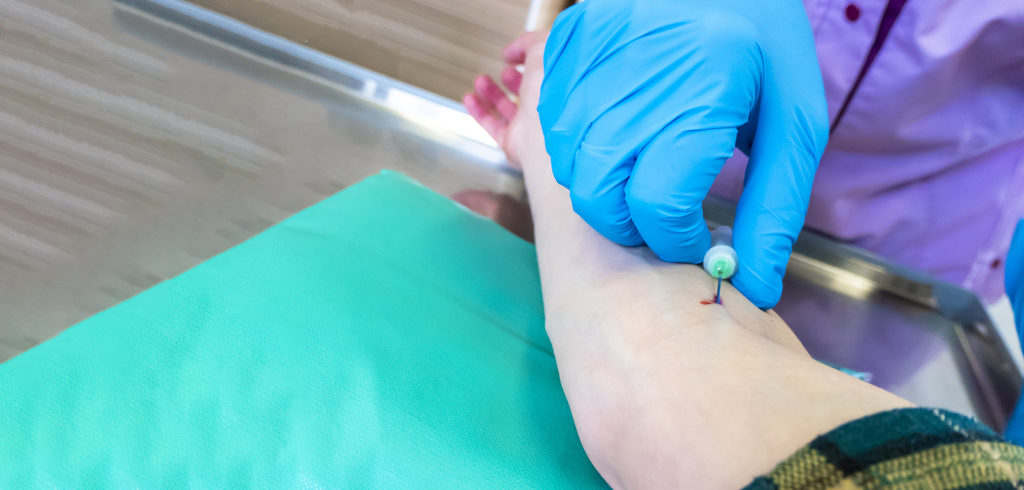
Not fully. Some lecture content may be offered in a hybrid format, but venipuncture is a hands-on skill and has to be practiced in person on real arms. Treat any program that promises a 100 percent online phlebotomy certificate with no live draws with caution.
Green River College's Medical Assistant Phlebotomy Certificate is 15 credits, about one quarter (3 months), and is listed as meeting Washington Department of Health training requirements for the Medical Assistant-Phlebotomist credential. It includes a required Medical Assistant Phlebotomy Laboratory course and teaches venous and capillary collection.
The college's pages disagree on format. One lists the program as in-person, while the program map lists in-person, hybrid and online options, and the 2026-2027 schedule uses codes for all three. Those listings do not show that the full certificate can be finished remotely, so confirm which sections meet on campus.
The research did not turn up the following for Green River:
There are also no confirmed clinical details for programs in Renton, Tacoma or other nearby cities.
Ask how many live venipunctures and capillary sticks you must complete, where they happen, and who arranges the site. Get the answers in writing before you pay.
Green River College is the one Auburn program whose costs you can price out line by line, and a realistic budget lands somewhere between roughly $2,360 and $2,550 before the add-ons.
Green River's estimated-cost page lists $2,386 in tuition and fees, $105 in textbooks and $51 in supplies for Washington residents, which works out to about $2,542. The 2026-2027 Nursing & Healthcare Studies Student Handbook gives a slightly different picture: $2,150 in tuition and fees plus $210 in supplies, so about $2,360 and up, plus a $145 Department of Health certification application fee, which pushes the all-in figure toward $2,505 and up. The program's own phlebotomy page rounds to about $2,300 for tuition and supplies. The college warns that tuition changes, course fees, textbook editions and individual purchases can move these numbers, and it does not tie either estimate to a specific start date. Budget for the higher figure and treat any savings as a bonus.
Neither estimate includes criminal background checks, drug screening, immunizations, uniforms, the national certification exam, BLS training or transportation to clinical sites. Those are requirements you pay for separately, and together they can add a few hundred dollars to the sticker price.
Green River's school-wide average net price sits near $13,800, an annual figure covering every program at the college, not a phlebotomy price. No other program serving Auburn students has a published 2026 cost to set beside these numbers.
At Green River College, phlebotomy training runs three months, or a single quarter, across 15 credits. That timeframe fits the statewide pattern for a short certificate rather than a two-year degree. If you want the clinical skills plus a broader patient-care credential, the college's separate ER and Patient Care Technician Certificate bundles nursing assistant and medical assistant phlebotomy coursework into 30 credits over two quarters, roughly six months.
The quarter certificate starts quarterly, with application deadlines of September 1 for fall, December 1 for winter, March 1 for spring and June 1 for summer. Seats are first come, first served and courses stay open until they fill, so apply early.
The 2026-2027 annual schedule lists in-person phlebotomy blocks, including an evening option from 2:00 PM to 10:00 PM on Monday and Friday, and daytime blocks on Wednesday from 9:00 AM to 5:00 PM and Thursday from 8:00 AM to 4:00 PM.
The published pages disagree on format: the main program page describes in-person delivery, while the program map also lists hybrid and online. No weekend-only or shortened accelerated track is documented. Confirm current section formats and exact start dates with the program before you plan around a schedule.
Below are the top phlebotomy programs serving Auburn students, ranked by federal completion data, accreditation status, and program fit for commuters. Green River College is the only one on the list located in Auburn itself; the rest sit within a commute of roughly 20 to 45 minutes across South King and Pierce County. Every school here awards a certificate, and each one prepares graduates to pursue Washington's Medical Assistant-Phlebotomist credential.
| Rank | School | Location | Net price | Best for | |
|---|---|---|---|---|---|
| #1 | Green River College | Auburn, WA | $4,700 – $5,000/yr (est.) | Auburn residents avoiding the commute | |
Green River College is the only school on this list with a phlebotomy program on an Auburn campus, so students here skip the freeway commute entirely. The college is a public two-year institution with a broad allied health division, and its phlebotomy certificate runs in person with instruction on venipuncture, capillary collection, EKG, and vital signs. Completion counts for this certificate are among the highest of the Washington schools listed, and Workforce Education funding can help eligible students cover tuition, books, and fees.
| |||||
| #2 | Renton Technical College | Renton, WA | $5,000 – $10,000/yr (est.) | Students wanting extra academic support | |
Renton Technical College is a public technical college in Renton with a hands-on health sciences division, and its phlebotomy technician certificate is the largest producer of completions among the Washington schools on this list. Coursework covers blood collection, specimen processing, infection control, anatomy, medical terminology, and OSHA safety standards, and students finish with CPR and First Aid certification plus a clinical externship. I-BEST support gives students extra help with math, reading, and writing alongside the technical training.
| |||||
| #3 | Bates Technical College | Tacoma, WA | ~$6,000/yr (est.) | Hands-on learners wanting clinical hours | |
Bates Technical College in Tacoma runs a phlebotomy program built around a substantial clinical placement, which suits students who want supervised patient contact before they job hunt. Instruction happens on campus in labs and lectures, with online assignments through Canvas, and the curriculum adds age-specific patient care, customer service, special collections, and non-blood sample processing to standard venipuncture training. Cohorts are capped, so seats are limited each term.
| |||||
| #4 | Bellevue College | Bellevue, WA | $11,000/yr (est. net price) | ||
Bellevue College is the largest institution on this list and its phlebotomy technician certificate is aimed at entry-level roles in outpatient settings such as doctor's offices and research labs. The program pairs foundation coursework in healthcare, medical terminology, and safety with a hands-on practicum externship. Bellevue carries the highest graduation rate of the schools ranked here, though that figure describes the college overall rather than the phlebotomy certificate specifically.
| |||||
| #5 | Shoreline College | Shoreline, WA | $5,000 – $8,000/yr (est.) | ||
Shoreline College offers one of the shortest phlebotomy certificates in the Puget Sound region, a focused course of study built for students who want to enter healthcare quickly. Training happens on campus and covers blood collection technique, safety and infection control, and specimen processing, with graduates heading into hospitals, clinics, blood banks, and medical labs. The college starts students in any quarter, which makes it easier to line up training around a current job.
| |||||
| #6 | Olympic College | Bremerton, WA | $7,000/yr (est. net price) | ||
Olympic College in Bremerton runs two separate phlebotomy tracks: one for students new to healthcare and one for working professionals who already hold a clinical role. Both combine online coursework with evening in-person labs, which fits students who need to keep daytime work hours. The college has the highest retention rate of the schools on this list, measured institution-wide rather than for the phlebotomy program alone.
| |||||
| #7 | Edmonds College | Lynnwood, WA | ~$11,000/yr (est.) | ||
Edmonds College in Lynnwood runs a compact phlebotomy technician certificate with a clinical externship and a curriculum designed around NAACLS standards. The program prepares students for the Washington MA-Phlebotomist license and for national certification through ASCP, and graduates move into hospitals, diagnostic labs, blood donor centers, and mobile phlebotomy. Credits can also be applied toward advanced certificates or a BAS in Integrated Healthcare Management for students who want to keep going.
| |||||
| #8 | Pima Medical Institute-Renton | Renton, WA | ~$32,000/yr (est.) | ||
Pima Medical Institute's Renton campus is the private career school option on this list, offering a phlebotomy technician certificate with a large supervised externship and a lab built to simulate clinical settings. Admission is selective and requires entrance exams, and the school reports high institution-wide completion and job placement figures. The program prepares graduates for the Certified Phlebotomy Technician credential through the National Healthcareer Association and cannot be completed entirely online.
| |||||
Run through this list before you pay a deposit, most of it takes one phone call or email to the program.
5 schools in the state offer this course through an education partner, with open enrollment and a national certification exam voucher. Request information to hear from the school directly.
Certified Phlebotomy Technician course (vouchers and lab included)
Certified Phlebotomy Technician course (vouchers and lab included)
Certified Phlebotomy Technician course (vouchers and lab included)
Certified Phlebotomy Technician course (vouchers and lab included)
Certified Phlebotomy Technician course (vouchers and lab included)
Sponsored listings. These schools offer the course through an education partner and may compensate us when you request information. Compensation does not affect the rankings or the directory on this page.
8 schools within 40 miles, grouped by city. Select a program to see its highlights, and use the Website link for the school's own program page.
Program data from the schools and the National Center for Education Statistics (IPEDS).
These are the questions readers ask most often when they are comparing phlebotomy classes around Auburn. The short answers are below, and where a rule depends on the school or the certifying body, confirm it with them before you pay a deposit.