Phlebotomy Classes and Training Programs in Minneapolis, MN
Compare local colleges and private training centers by length, true cost and clinical hours
By Marcella Sanchez, CPTReviewed by Editorial TeamUpdated November 4, 202617 min read
Most important takeaways…
Minneapolis-St. Paul phlebotomists earned a $46,460 median wage in May 2024.
Credit certificates may require 100 clinical hours; some private courses take days.
Minnesota does not license phlebotomists, but employers expect national certification.
How quickly can you go from a classroom to drawing blood in Minneapolis? Phlebotomy training typically runs 4 to 16 weeks, or 40 to 200 hours, so a job within months is realistic for most commuters.
Programs range from community and technical college certificates to short private training courses, with campuses in suburbs such as Brooklyn Park and White Bear Lake. Cost, evening or weekend scheduling, externship hours and certification support vary widely from one to the next.
Minnesota does not license phlebotomists, so employers lean on national certification and documented clinical draws to separate candidates. Jump straight to the program list →
Where Minneapolis Phlebotomists Work: Hospitals, Labs and Blood Centers
In the Twin Cities, choosing a phlebotomy employer means choosing a schedule and a pace: the same credential leads to very different workdays depending on the setting.
Who Hires Here
Hospital systems and reference labs dominate. Hennepin Healthcare, Allina Health, M Health Fairview and North Memorial all hire phlebotomists and combined phlebotomy/EKG technicians across Minneapolis and their suburban sites. Quest Diagnostics, HealthPartners/GHI and GTT were among the most active local recruiters in a fall 2026 market snapshot, and Allina Outreach carried roles of its own2. Blood collection is a separate lane: the American Red Cross staffs a Saint Paul donor center, hires full time, pays during training and asks for no prior medical experience1. That same snapshot counted 72 live openings from 18 employers, with more than half entry level, so new graduates are applying into a real market rather than waiting for one2.
How the Work Changes by Setting
Hospital floors: early starts and inpatient draws. Allina's full-time Minneapolis posting runs 5:30 AM to 2:00 PM with no set days off, and overnight or weekend coverage is common1. Float pools move you where the need is that week.
Outpatient labs and clinics: daytime hours, high volume, a mix of scheduled and walk-in patients.
Donor centers: collection from healthy donors rather than diagnostic draws, including weekend rotation.
Why the Externship Site Matters
Your clinical placement is a working audition. Supervisors see how you handle a difficult draw and a rushed morning, and students who fit the floor tend to hear about openings first. Pick a training site whose employer you would actually want on your badge.
College Certificates vs. Private Training Centers in the Twin Cities
Saint Paul College's Phlebotomy Technician Certificate takes 22 credits and includes 100 clinical hours, while Northwest Phlebotomy School teaches its course in two or three days. Those two timelines frame the basic split between college and private programs here.
College Programs
Saint Paul College (Marshall Avenue campus) awards a true college certificate. Classes are a mix of online, day, evening and Saturday sections. On-campus coursework comes first, then you complete the clinical affiliate experience. Because the credential is credit-based, ask the financial aid office what you qualify for.
Hennepin Technical College (Brooklyn Park campus) is different. Its Phlebotomy (CTS) is a continuing education credential, not a college certificate. It has 58 hours of in-person instruction and a possible 60 to 100 hours of clinical internship.
Private Training Centers
Both private centers award no college credit. They prepare you to sit a national certification exam.
Northwest Phlebotomy School (South 4th Street): A two- or three-day in-person course combining lab and lecture. The published schedule runs 10:00 a.m. to 3:00 p.m.
Phlebotomy Training Specialists (Broadway Street NE): 48 in-person hours, split evenly between 24 hours of instructor-led discussion and 24 hours of hands-on training, ending with an in-class practical exam.
Private centers finish faster, but their hands-on time is much shorter than a 100-hour clinical placement. Check with each center whether it arranges any additional live-draw experience, since many employers want it.
The Online Question
Some programs, Saint Paul College among them, deliver coursework online. Every program still requires in-person draws, and no legitimate phlebotomy program is fully online. If a school promises certification with no hands-on practice, look elsewhere.
Full addresses and program details appear in the listing below.
How Much Phlebotomy Classes Cost in Minneapolis
Prices below are 2026 figures as each program publishes them, split into tuition, fees and exam costs; anything a program does not post is marked "Not listed" rather than estimated. Hennepin Technical College charges per credit and does not post a phlebotomy total, while the private centers quote flat tuition, so a college certificate and a short private course are not a like-for-like comparison until you know the credit count and every add-on. If a program leaves out the exam fee, plan on paying the certifying body directly: in 2026 the NHA CPT exam is $125 and the ASCP PBT exam is $155.
Program
Type
Location
Tuition
Registration and Supply Fees
Exam Fee
Estimated Total
Hennepin Technical College, Phlebotomy (CTS)
College certificate (58 hours)
Not listed
$202.32 per credit (2026-27)
$20 application fee; $10.90 technology fee and $1.31 health services fee per credit; textbook and course materials included
Not listed
Not listed
Northwest Phlebotomy School
Non-credit hybrid course
Not listed
$1,600 flat
Not listed
Not listed (ask whether an NHA CPT voucher is included)
Not listed
Phlebotomy Training Specialists Minneapolis
Private training center
Not listed
$675 (2-day course) or $775 (3-day course)
Not listed
$50 optional NHA CPT voucher add-on
Not listed
TC Med Train
Private training center
Not listed
$500
$146 non-refundable registration; labs and study guide included
How Long Phlebotomy Training Takes: Weekday, Evening, Weekend and Accelerated Options
Phlebotomy training in Minneapolis is short by design, but the calendar can stretch well past the last class once clinical hours are counted. Plan on a few months, not a few weekends, unless you already work in healthcare.
The Shortest Formats
Intensive, one-week or two-to-three-day boot camps are built for people who already have patient-care experience, such as medical assistants, EMTs or nursing students. These compress the classroom piece only. They are a poor fit for a true beginner, who needs supervised draws before sitting for a national exam.
What the Local Programs State
Hennepin Technical College describes its Phlebotomy Certificate of Completion as three months of hands-on classroom and clinical practice followed by an internship; the full sequence can finish in as little as five months. The program page lists 58 hours of in-person instruction. It does not publish whether sections run days, evenings, weekends or in an accelerated format.
Saint Paul College's 2026 Phlebotomy Technician course is hybrid and explicitly evening-based: one campus meeting per week for skills practice, 5:00 to 9:00 pm, plus roughly three hours of online coursework weekly. The published 2026 sequences start February 4, April 1 and July 9, and each runs five dates for 20 scheduled in-person hours. Clinical hours and total weeks beyond those dates are not detailed.
TC Med Train in Minneapolis advertises 40 hours of in-person certification training. The school does not break that down into classroom versus clinical time, or state how many weeks the program runs.
Counting the Real Finish Date
Classroom hours and clinical or externship hours are usually tracked separately, so a certificate that looks like ten or twelve weeks of instruction can run several weeks longer before you are exam-eligible. Ask each school for the total clock hours and the clinical placement timeline in writing.
Start dates shift every term. Confirm current openings directly with the school rather than relying on a catalog from an earlier term.
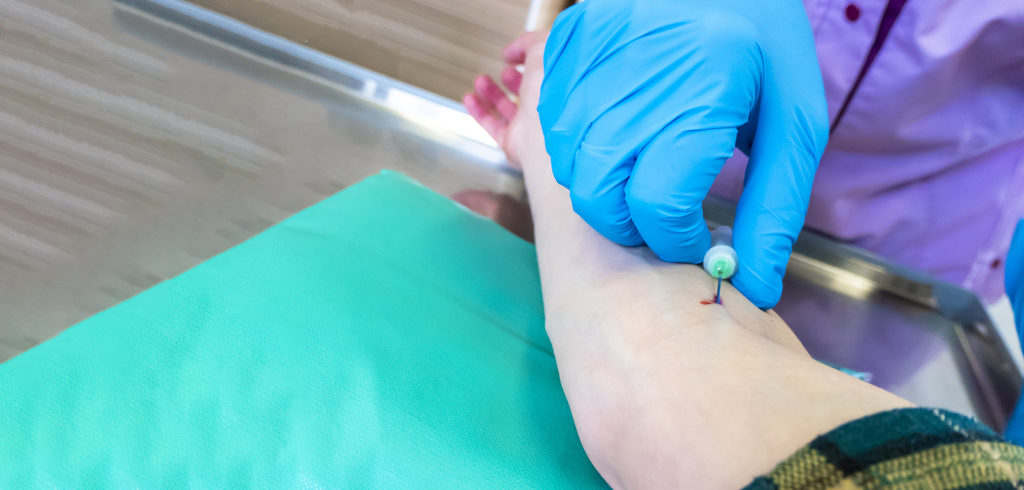
A short course or a low price means little if it skips supervised clinical draws. Hands-on venipuncture on real patients, under a working phlebotomist's eye, is what builds the skill employers look for when they hire.
phlebotomytraining.org
What Phlebotomists Earn in the Minneapolis-St. Paul Metro
Bureau of Labor Statistics data for May 2024 put the median annual wage for phlebotomists in the Minneapolis-St. Paul-Bloomington, MN-WI metro at $46,460, with about 1,140 people employed in the role. The middle half of earners made between $44,910 and $50,020 a year in that period, so most local pay falls in a fairly narrow band. Setting matters within that band: hospital roles with night or weekend shifts often carry differentials that can lift earnings above what a daytime outpatient lab draw station pays.
From First Class to Certified: How Does the Minneapolis Phlebotomy Path Work?
Minnesota does not license phlebotomists, so national certification is voluntary but expected by most Twin Cities employers. Only California, Louisiana, Nevada and Washington license phlebotomists at the state level. The Minnesota state page on phlebotomytraining.org covers the statewide rules in more detail.
Ranked Phlebotomy Programs Serving Minneapolis Students
Three colleges within commuting distance of Minneapolis award a phlebotomy certificate, and each suits a different kind of student. One is a credit-bearing community college certificate, one is a continuing education course built for adults changing careers, and one leans hardest on patient-interaction skills.
How we ranked these
Factors considered
Net price after financial aid
Median graduate debt levels
Program relevance and format
Commute distance from Minneapolis
Institution-wide graduation rates
Data sources
NCES-IPEDS federal institutional data covering graduation rates, retention rates and student-faculty ratios — nces.ed.gov
BEA state price parities, used to adjust tuition — bea.gov
North Hennepin Community College sits in Brooklyn Park, roughly 20 minutes northwest of downtown Minneapolis, and delivers its Phlebotomy Technician Certificate in person through the Nursing and Health Professions department. The certificate runs one or two semesters across 9 credit hours, combining classroom and lab work with a clinical practicum in real medical settings, and the college says it plans to seek NAACLS accreditation. Financial aid, scholarships including the North Star Promise, and a curriculum that also feeds into nursing or medical lab technology make it a good fit for commuters who want college credit on the way to a first healthcare job. The graduation rate published for this college covers the whole institution, not the phlebotomy certificate alone.
Finish in one or two semesters; 9 total credit hours
Minimum 2.0 GPA and a program application required
Hands-on labs plus clinical experience in professional settings
In-person delivery on the Brooklyn Park campus
Financial aid, scholarships and North Star Promise support
College plans to seek NAACLS accreditation for the certificate
Builds a foundation for nursing or medical lab technology study
Adult career changers entering via continuing education
Hennepin Technical College, also in Brooklyn Park, offers its Phlebotomy (CTS) certificate through Continuing Education rather than the academic division, which suits adults returning to school after time away. The program runs about five months with 58 hours of in-person instruction and a possible 60 to 100 hour clinical internship, and it prepares students for recommended certification testing. Entry requires an Accuplacer reading assessment (available free at the campus testing center, with transcript waivers possible), proof of immunizations, and a background check, and qualifying students may access WIOA tuition reimbursement. The college's overall graduation rate is an institution-wide figure, not a phlebotomy program outcome.
About 5 months with 58 hours of in-person instruction
Possible 60 to 100 hour clinical internship
Accuplacer reading exam required; free at the campus testing center
Qualifying transcripts may earn a test waiver
Proof of immunizations and a state background check required
WIOA tuition reimbursement for qualifying students
Prepares students for recommended certification testing
Continuing Education format; applicants must be 18 or older
East metro residents wanting hands-on patient interaction
Century College in White Bear Lake puts students on campus for a Phlebotomy Technician program built around routine procedures, from venipuncture to capillary sticks, with a strong emphasis on how to work with patients and the providers around them. Safety protocols, specimen handling and infection control are part of the curriculum, and the skills carry over into patient care technician or nursing assistant roles. The commute runs about 25 minutes northeast of downtown Minneapolis, and Century carries the lowest published net price after aid of the three. Its graduation rate is an institution-wide figure rather than a program-specific one.
On-campus training in venipuncture and capillary collection
Coursework covers safety protocols, specimen handling and infection control
Emphasis on patient and provider interaction best practices
Skills transfer to patient care technician and nursing assistant roles
Prepares graduates for hospital, clinic, blood bank and lab roles
Do you need an evening or weekend section around a current job, or can you attend a weekday intensive?
A weekday intensive gets you to the exam faster but can mean cutting work hours. An evening or weekend section takes longer, so check the program's stated schedule and total weeks before you commit.
Does the program place you in an externship, or will you have to find your own clinical site?
Supervised draws on real patients are what employers look for. A program that arranges your clinical placement saves you weeks of searching, so ask where students draw and whether a site is guaranteed.
Is the certification exam fee included, and which exam does the program prepare you for?
Some tuition quotes leave out the exam fee, which raises your real cost. Confirm whether the program prepares you for the NHA CPT, ASCP PBT, AMT RPT or NCCT NCPT, and check which one local employers prefer.
Would a college certificate that qualifies for financial aid cost you less out of pocket than a cheaper private course?
A lower sticker price is not always the cheaper choice. If a college certificate qualifies for financial aid and a private course does not, compare what you would actually pay after aid, not the posted tuition.
How to Enroll: Prerequisites, Funding and Questions to Ask
Requirements vary by provider and clinical site, so confirm each item in writing with the program before you pay a deposit.
Age and education
Expect to be at least 18 and to hold a high school diploma or GED. Some programs also ask for a recent biology course with a grade of C or better.
Background check
Most programs require one before class starts. A felony conviction can block clinical placement even if your tuition is funded.
Immunizations and TB test
Minnesota State classes require immunizations before class. Most clinical sites require flu and COVID-19 vaccines, with medical exemptions only by written physician documentation. Many programs also ask for a two-step TB test, hepatitis B, MMR and varicella records, and Tdap within 10 years.
CPR and placement testing
Some programs require American Heart Association CPR at the healthcare provider level. Minnesota State may require an Accuplacer reading score unless you are exempt.
CareerForce/WIOA funding
WIOA can cover tuition for eligible job seekers. Eligibility is decided by CareerForce staff. WIOA Adult requires age 18 or older, legal work authorization and Selective Service registration where it applies. The Dislocated Worker track covers laid-off workers, including the 27-week unemployment rule. Your program must be on the Eligible Training Provider List. Bring photo ID, your Social Security card, work authorization and proof of income.
American Indian OIC/Takoda
Takoda determines eligibility for its workforce-funded training, so ask its staff directly.
Questions to ask
Get the refund policy in writing. Ask whether the school places you in an externship or expects you to find one. Confirm that completing the program makes you eligible for the national certification exam you plan to take, and check that answer with the certifying body.
Phlebotomy Training Programs Accepting Students Near Minneapolis, MN
9 schools in the state offer this course through an education partner, with open enrollment and a national certification exam voucher. Request information to hear from the school directly.
Certified Phlebotomy Technician course (vouchers and lab included)
Sponsored listings. These schools offer the course through an education partner and may compensate us when you request information. Compensation does not affect the rankings or the directory on this page.
Every Phlebotomy Training Program Near Minneapolis, MN
3 schools within 40 miles, grouped by city. Select a program to see its highlights, and use the Website link for the school's own program page.
Program data from the schools and the National Center for Education Statistics (IPEDS).
Minneapolis Phlebotomy Training FAQ
How much do phlebotomy classes cost in Minneapolis?
Prices vary widely. An intensive weekend option runs $675 to $775, Penn Foster is $1,099 in 2026 with a promotion, and a non-credit hybrid is $1,600. A 200-hour program costs $2,295, and a credit certificate costs $4,400. Credit prices often exclude books, supplies and exam fees.
How long does phlebotomy training take in Minneapolis?
It depends on the format. Intensive options run 2 to 3 days with no externship. Penn Foster and the 200-hour program are self-paced within 12 months. WIOA-approved programs statewide report 4 to 12 weeks. Minnesota sets no statewide duration, so confirm the schedule with each provider.
Do you need to be certified to be a phlebotomist in Minnesota?
No. Minnesota requires no state license, state exam or state certification. Employers still often expect national certification, plus a high school diploma or GED and a background check. Mayo Clinic graduates, for example, are eligible to sit the NHA or ASCP exams.
Are there free phlebotomy classes in Minneapolis, MN?
Don't assume any program is free. Mayo Clinic's program is tuition-free through its Workforce Development Scholarship, but other costs may still apply. WIOA funding is eligibility-based, with priority for public assistance recipients and low-income adults 18 and older. Eligibility is decided before training begins.
Which phlebotomy programs in Minneapolis include an externship?
Penn Foster requires a 40-hour externship at an arranged Minneapolis to Saint Paul host site. The 200-hour $2,295 program also requires an externship after the academic work. Mayo Clinic requires 100 clinical collections. The intensive 2 to 3 day option has no externship.